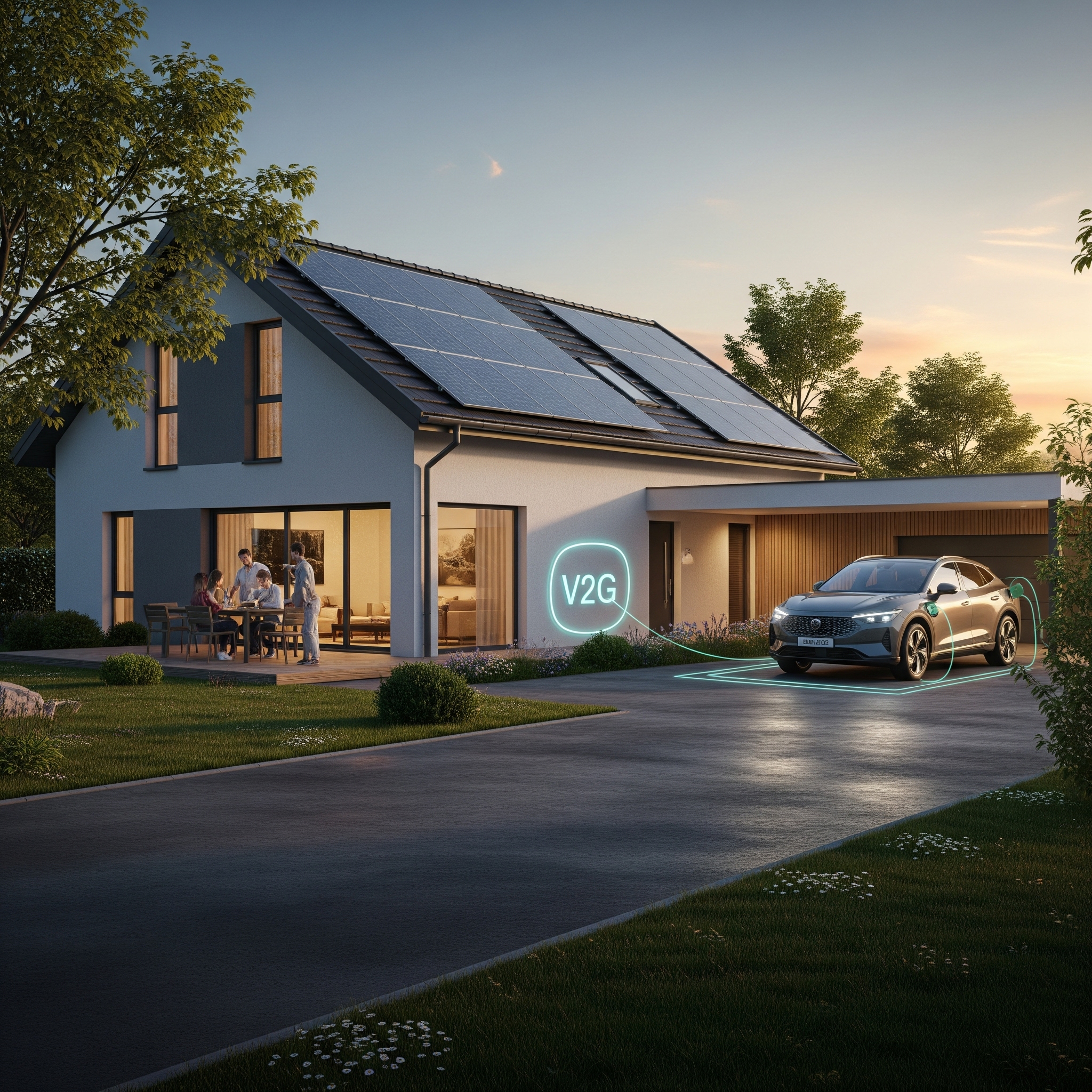
Vehicle-to-grid, or V2G, lets an electric vehicle do more than drive. With the right charger, an EV battery can take in electricity and also send it back out to a home or the power grid. Paired with rooftop solar, that turns a parked car into a battery that can store sunshine for the evening.
Quick answer: Vehicle-to-grid integration uses a bidirectional charger to charge an EV with extra midday solar power and then discharge it to your home or the grid during evening peak hours, when power is more expensive and often dirtier. It needs a compatible EV, a bidirectional charger and approval from your utility.
How vehicle-to-grid works
A normal EV charger moves power one way: from the grid into the car. A bidirectional charger can move power both ways. The California Energy Commission groups this under vehicle-grid integration, which includes managed or “smart” charging and bidirectional charging such as vehicle-to-home (V2H) and vehicle-to-grid (V2G) (California Energy Commission).
With V2H, the car powers your own house, for example during an outage or at peak-price hours. With V2G, the car can also send power back to the wider grid, often through a utility program that pays for that help.
Why solar and V2G fit together
Solar panels make the most power around midday, but households and the grid need the most power in the late afternoon and evening. The U.S. Energy Information Administration reports that solar supplies almost half of California grid operator CAISO’s electricity demand between 8 a.m. and 4 p.m., and that in 2024 CAISO curtailed 3.4 million megawatthours of wind and solar output, a 29% increase from 2023 (EIA). Curtailed power is clean electricity that goes unused because there is nowhere to put it.
An EV plugged in at home during the day can soak up extra solar power, then help cover your household’s needs during the 4–9 p.m. peak that many California utilities, including SCE, use in their time-of-use rates. Under California’s current net billing rules for new solar customers (often called NEM 3.0), exported solar usually earns less than it used to, so using more of your own solar at home can make more financial sense.
Benefits for the grid and your battery
The National Renewable Energy Laboratory (NREL) has found that parked EVs can supply power back to homes and communities during periods of peak demand, and that a network of EV batteries could act as distributed backup power (NREL). NREL’s research also suggested that taking part in V2G can lower a battery’s average state of charge while parked, which may help batteries stay healthier and last longer.
For the grid, many EVs working together can ease strain during heat waves and reduce the need to run fossil-fuel peaker plants. For households, a car battery you already own can do some of the job of a separate home battery.
What to know before you try it
V2G is still growing, and not every setup can do it yet:
- Your EV must support bidirectional charging. Only some models can send power out, and the feature may depend on software and the charger.
- You need a compatible bidirectional charger, installed by a licensed electrician.
- Your utility must approve the connection. Sending power to the grid requires interconnection approval, and paid V2G programs vary by utility.
- Tax credits have changed. The federal clean vehicle credits for new and used EVs ended for vehicles acquired after September 30, 2025, and the federal residential clean energy credit for home solar and batteries ended for systems placed in service after December 31, 2025. Check current state and utility incentives before you budget.
- Check the warranty. Ask the automaker how bidirectional use affects your battery warranty.
Frequently asked questions
What is the difference between V2G and V2H?
V2H (vehicle-to-home) sends power from your EV to your own house, usually through a special transfer switch or home energy system. V2G (vehicle-to-grid) sends power back to the utility grid, often as part of a program that pays for the service.
Can any electric vehicle do vehicle-to-grid?
No. The car, the charger and the software all have to support bidirectional power flow. Check with the automaker and charger maker, and look for chargers that are approved by your utility.
Does V2G wear out an EV battery faster?
It depends on how often and how deeply the battery is cycled. NREL research found that V2G participation can lower a battery’s average state of charge while parked, which may help battery health, but you should still review your automaker’s warranty terms.
See your impact
Want to see how driving electric and charging with solar change your footprint? Try our free My Transportation Simulator to compare your household’s travel emissions and test different vehicle and charging choices.
Related guides
- Sustainability at the Forefront: The Implications of NFPA 70 2026 for EV Adoption
- How to Pair a Home Battery Bank with Your Solar Panels
- Solar Power Takes Center Stage: How 2024 Became the Year the U.S. Grid Went Big on Sunshine
Sources
- U.S. Energy Information Administration, Solar and wind power curtailments are increasing in California
- National Renewable Energy Laboratory, Electric Vehicles Play a Surprising Role in Supporting Grid Resiliency
- California Energy Commission, Vehicle-Grid Integration
Written and reviewed by the Accessible Sustainability Alliance editorial team. Last updated October 5, 2026.