You can clear leaves from a driveway, patio or small yard with a stiff push broom and a leaf rake. You skip the fuel, fumes and noise of a gas leaf blower, and you get some outdoor exercise. This guide shows you how, plus what to do with the leaves when you are done.
Quick answer: Sweep hard surfaces with a push broom and rake the lawn into small piles; the California Air Resources Board says one hour of a commercial backpack gas leaf blower can make as much smog-forming pollution as driving a car about 1,100 miles.
Why it matters
Small gas engines, like the ones in leaf blowers and lawn mowers, are big polluters for their size. According to the California Air Resources Board (CARB), a commercial operator using one backpack leaf blower for one hour can create the same smog-forming emissions as a car driving 1,100 miles. A broom and rake make none.
Leaves also matter after you collect them. CalRecycle says organic waste like yard trimmings and food scraps makes up half of what Californians send to landfills, and organic waste in landfills is a source of methane, a strong climate pollutant. You can see how yard care fits into your household’s footprint with the Household Carbon Simulator.
What you need
- A push broom with stiff bristles for concrete and pavers
- A fan-shaped leaf rake for grass
- A tarp or old sheet to drag leaves
- Gloves to prevent blisters
- Your green organics bin, a compost pile or garden beds
How to rake leaves with a push broom
- Start on hard surfaces. Sweep driveways, walkways and patios with the push broom, working from the edges toward the middle.
- Use short, firm pushes. Keep the broom low and push leaves in one direction instead of flicking them into the air.
- Switch to the leaf rake on the lawn. Pull leaves toward you in rows, working with the wind, not against it.
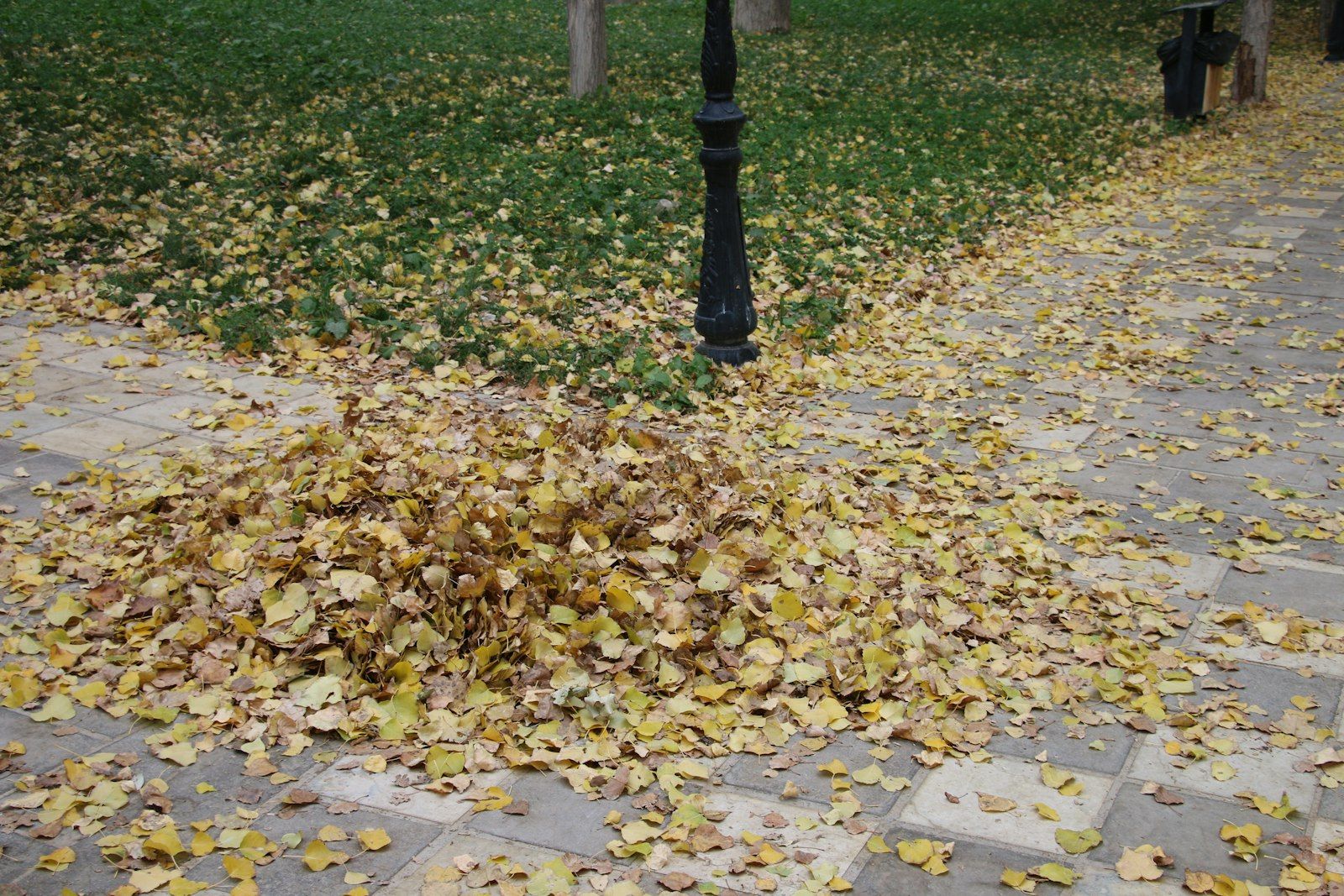
- Make several small piles. Small piles are easier to move than one huge pile and are less likely to blow away.
- Rake piles onto a tarp. Lay the tarp flat, rake the pile onto it, then drag the tarp to your green bin, compost pile or garden beds.
- Finish with a quick sweep. Go back over hard surfaces to catch any leaves that blew back.
- Repeat once a week during heavy leaf fall. Smaller, regular sweeps are easier than one big cleanup.
What to do with the leaves
- Put them in your green organics bin. Under California’s SB 1383 organic waste law, cities must offer organics collection to all residents and businesses.
- Use them as mulch. Spread a thin layer on garden beds to help hold in moisture.
- Add them to compost. Dry leaves are a good “brown” material to balance food scraps.
- Leave some in place. A few leaves under shrubs give shelter to insects and birds.
Do not sweep leaves into the street or storm drain. Storm drains often flow to creeks and the ocean without treatment.
Is California banning gas leaf blowers?
California’s rules focus on new equipment, not the blower you already own. Assembly Bill 1346 told CARB to set rules for new small off-road engines, such as those in leaf blowers, mowers and generators. CARB’s FAQ says U.S. EPA authorized the rules on January 6, 2025, CARB then began full implementation with the 2026 model year, and by model year 2028 the smog-forming emission standards for new engines are zero.
The same FAQ says the rules do not ban gas equipment, and you can keep using, repairing and maintaining CARB-certified gas equipment for its full useful life. In June 2026, U.S. EPA sent the authorization to Congress for review, so check CARB for the latest status. Some cities also set their own leaf blower limits. For the full timeline, read our California gas leaf blower ban explainer.
Tips
- Sweep when leaves are dry. Wet leaves stick to pavement and get heavy.
- Rake with the wind at your back so leaves move with you.
- Choose a broom with stiff bristles for rough concrete and softer bristles for smooth patios.
- If you still want a blower, look at a battery-electric model, which has no exhaust.
Frequently asked questions
Is a push broom faster than a leaf blower?
For a small driveway, patio or walkway, a push broom can do the job without much extra time. For large lawns, a rake and tarp work well if you clear leaves often. Time depends on your yard size and how many trees you have.
Can I still use my gas leaf blower in California?
CARB says its small engine rules do not ban gas equipment you already own, and you can keep using and repairing it. Your city may have its own limits on when or where gas blowers can be used, so check local rules.
Should I rake leaves or leave them on the lawn?
A thick layer of wet leaves can block sunlight and smother grass. A thin layer that you chop up with a mower can break down into the lawn. Rake heavy piles off and use them as mulch or compost.
What is the best broom for sweeping leaves?
A wide push broom with stiff bristles works best on concrete, asphalt and pavers. A fan-shaped leaf rake works better on grass because it slides over the lawn without tearing it.
Can leaves go in the green bin?
In most California cities, yes. Leaves and other yard trimmings go in the green organics bin. Check your city or hauler’s list to be sure.
See your impact
Every gas-free cleanup cuts pollution where you live. Try the Household Carbon Simulator to see how yard care, travel and energy use add up for your household, and find your next step.
Related guides
- California Gas Leaf Blower Ban Explained: What Changed in 2026
- How to Mow Your Lawn Gas-Free with a Push Reel Mower
- Household Carbon Footprint: What It Is and How to Calculate It
Sources
- California Air Resources Board, CARB approves updated regulations requiring most new small off-road engines be zero emission by 2024
- California Air Resources Board, Small Off-Road Engine Regulations Frequently Asked Questions
- California Air Resources Board, 2021 – Assembly Bill 1346 (Berman, Marc), Small Off-Road Engines (Chaptered)
- CalRecycle, California’s Short-Lived Climate Pollutant Reduction Strategy
Written and reviewed by the Accessible Sustainability Alliance editorial team. Last updated November 2, 2026.